HOME |
DEUTSCH
Allat
Allat Info
by
Diane Neisius
Allat (Arabic: 'the Goddess'), also Al-Lat, Alilat, Al-Ilat or Elat was a pagan Goddess of Arabia and
formed probably also a triple Goddess together with Al-Umma and Al-Manat. She was worshipped
in shape of a cube.[1]
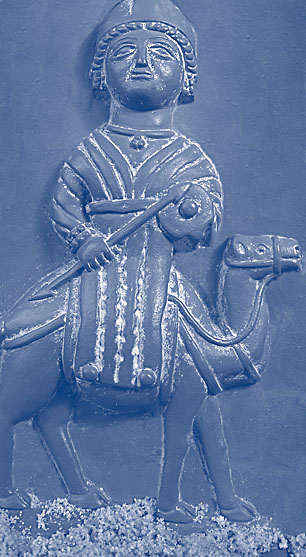
Images show Her also as a female figure holding ears or a palm front in Her hand, sometimes
accompanied by a lion. Other images show Her riding a camel. In Syria She was worshipped also as
Al-Lat-Athena and (later, in Roman time) Al-Lat-Minerva, statues have been found in Palmyra. The
Nabateans worshipped Her as Mother of the Gods. She was even worshipped in Mesopotamia
where She was identified with Ishtar.[2]
She was also a Moon Goddess, her symbol was the crescent moon, and in ancient times the Kaaba
(Arabic: 'cube', there were many of them among Arabia) was Her temple. [3] Thus She was indeed
worshipped in a cube (see above).
Other source claims She also was a powerful Sun Goddess, covering almost all aspects of daily life
- love, fertility and death - granting protection and could even travel between the realms of the
living and the realm of the death (which is clearly a connection to the Goddesses Ishtar and
Astarte).[4]
Worship of Her was also at a large raw granite rock in some distance to Mekka. It symboled the
pure strength and the "rock-solid stand" of the Goddess.[5]
Herodot even identified Her with Aphrodite and Urania.[6]
Under impression of all these references I'd see Allat as a very universal Goddess for common
people in Arabia and Near East in the pre-monotheistic age. She certainly watched over love, about
founding a familiy, prosperity and protection not only of the children but all family members from
sickness and accidents. Even when a life came to it's end, Allat cared to guide the soul to the
underworld.
In public affairs, as a Goddess of Sun and Moon she also cared for natural phenomena. I think it is
quite probable She also was asked for protection and prosperity of the tribe by the politcal and/or
religious leaders in certain situations. Because She was identified also with Ishtar I expect She also
was asked for luck in case of a war.
In a way Allat was always present in all aspects of daily life of people of that time. So, one may not
wonder why Her name simple means 'the Goddess'. She was the one to ask for help if something
unexpected, risky or dangerous was to be done, even if just in a small scale.
Thus I think there was a rich religious life around the temples (the Kaabas), with personal worship
as well as public festivals, maybe also pilgrimage to the more famous Kaabas and temples in the
large area where the Goddess was worshipped.
With upcoming Christian belief in the Roman Empire the worship of Allat started to fade as well as
for other pagan deities in Near East and Arabia, same way as reported in Europe. There is no
archaeologic evidence for pagan temples in Arabia after the year 400.[7] At that time probably most
Arabs already where Christans or Jews. Ancient reports from the time just before Islam describe the
Kaaba as being empty, inside only wall paintings of Mary and Jesus.[8]
However, in 1979 during the seizure of the Great Mosque and Kaaba in Mekka by rebels, at relief
by police and armed forces a bomb detonated inside the Kaaba, damaging the floor. Below it some
pre-islamic idols were found. They were quickly removed by Saudi-Arabian government. It is not
known where they are today.[9]
The latter reminds me on lore about Northern Europe just after Christianization. It was reported the
freshly baptized people tended to hide idols of their former Gods and Goddesses below or behind
the altar of a church - maybe "just for the case".
Literature
[1] https://en.wikipedia.org/wiki/Al-L%C4%81t
[2] Ibid.
[3] Barbara Walker: The Women's Encyclopedia of Myths and Secrets. HarperCollins, New York 1983
[4] https://godsandmonsters.info/al-lat/
[5] Patricia Monaghan: The Book of Goddesses and Heroines, 1991
[6] https://en.wikipedia.org/wiki/Religion_in_pre-Islamic_Arabia
[7] https://de.frwiki.wiki/wiki/Arabie_pr%C3%A9islamique
[8] Ibid.
[9] https://de.wikipedia.org/wiki/Besetzung_der_Gro%C3%9Fen_Moschee_1979 (only in the German version).
© 2026
Lyceum of the Protecting Shield